
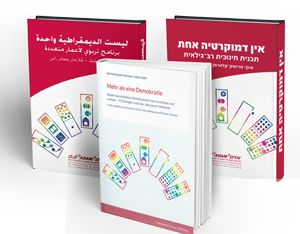
 This modular program for teaching democracy is based on the Adam Institute’s book There Is No Single Democracy, which serves as its foundation. The book includes seven chapters, each presenting a different approach to democracy currently debated: neutral liberal democracy, value-based liberal democracy, social democracy, socialist democracy, multicultural democracy, national democracy, and feminist democracy.
The program combines the book’s theoretical framework with practical, participatory activities. The book contains around 500 pages of articles and 73 hands-on exercises designed to explore fundamental democratic principles and their application in complex social contexts in Israel and worldwide. Each chapter focuses on a core value or principle—such as equality, rights, or participation—and examines it across the seven approaches to democracy, offering workshops and activities that allow participants to experience the different interpretations of these values.
The modular structure allows the program to be adapted to different educational settings and age groups. It also serves as the basis for training courses in democracy education, providing a broad and nuanced framework for applying democratic and humanistic values in daily life, while encouraging ongoing reflection on their relevance in a changing social reality. This program is suitable for educators in formal and informal settings, public officials, community activists, NGO members, and anyone interested in social and political processes and democratic governance.
 In the Path of Dialogue – is a practical educational program designed to address racism and incitement in Israeli society in general, and in schools in particular. Its goal is to promote the values of shared life, tolerance, multiculturalism, mutual respect, protection of human rights, social responsibility, and a sense of belonging to both the community and Israeli society. In the program, participants explore the principles of democracy, the meaning and impact of racism and incitement—especially toward minorities and foreigners—and ways to actively reduce these phenomena in schools and in the environments where young people engage.
Learning takes place through experiential workshops that combine theoretical study with personal and group-based activities, focusing on key democratic issues essential for understanding racism and incitement. Throughout the program, participants examine everyday incidents involving racism and incitement in light of the values learned, while sharpening the distinction between freedom of expression and its importance to democratic life, and the phenomenon of incitement. The program also deepens understanding of the differences between various forms of discrimination and racism in its different manifestations.
Following this reflective process, students are given the opportunity to take initiative, lead, and become actively involved by designing and implementing a school-based project on the topic, and are provided with the tools to do so.
The program can be implemented in three stages, though not all are required: teacher training to introduce the program and classroom tools; student workshops on democratic values, racism, and incitement; and school-based projects where students apply what they’ve learned. The program also includes joint encounters between Jewish and Arab students, religious and secular, to reflect on the content and foster collaborative projects.
Since 2012, the program has been implemented in dozens of Jewish and Arab schools and has received significant recognition. Between 2015 and 2019, it was carried out in partnership with the Ministry of Education, reaching approximately 21,000 students and teachers. In this framework, encounters were held between students from diverse sectors of Israeli society—including Jewish, Muslim Arab, Christian Arab, Bedouin, and religious Jewish communities—during which participants collaborated to plan and develop 35 joint educational projects addressing racism across different schools throughout the country.
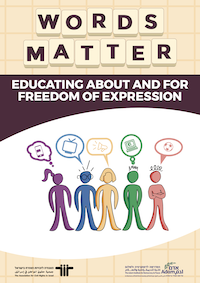 Words Matter: Educating about and for Freedom of Expression is an educational program that explores the vital role of freedom of expression in a democratic society, while fostering the ability to distinguish between legitimate expression, incitement, and racist speech.
The program examines the central importance of free speech to democratic governance and everyday life, including academic and artistic freedom, while addressing the tensions and conflicts that may arise between freedom of expression and both democratic and non-democratic values. It also engages with the challenges of free speech in the digital sphere, including phenomena such as shaming and online talkbacks, and considers freedom of expression within the education system—for both educators and students. A key component of the program is encouraging social engagement among teachers and students to defend freedom of expression while actively confronting incitement to racism.
Combining theoretical foundations with 40 structured lesson plans, the program provides practical tools for discussing current events through the lens of free expression and its limits. The curriculum is organized into seven chapters, each addressing a different dimension of the topic, with the overarching goal of safeguarding freedom of expression from undue restrictions while ensuring it is not misused to promote violence or unethical behavior.
The program is a collaborative initiative of the Adam Institute and the Association for Civil Rights in Israel (ACRI), developed and implemented jointly with the organization’s Department of Education. It reflects the extensive knowledge accumulated by both organizations, both at the theoretical level and through practical work in civil society and the legal arena. Included in the Ministry of Education’s “Gefen” system, the program has been implemented in 58 Jewish and Arab secondary schools, within which 25 joint school projects on the topic were developed.